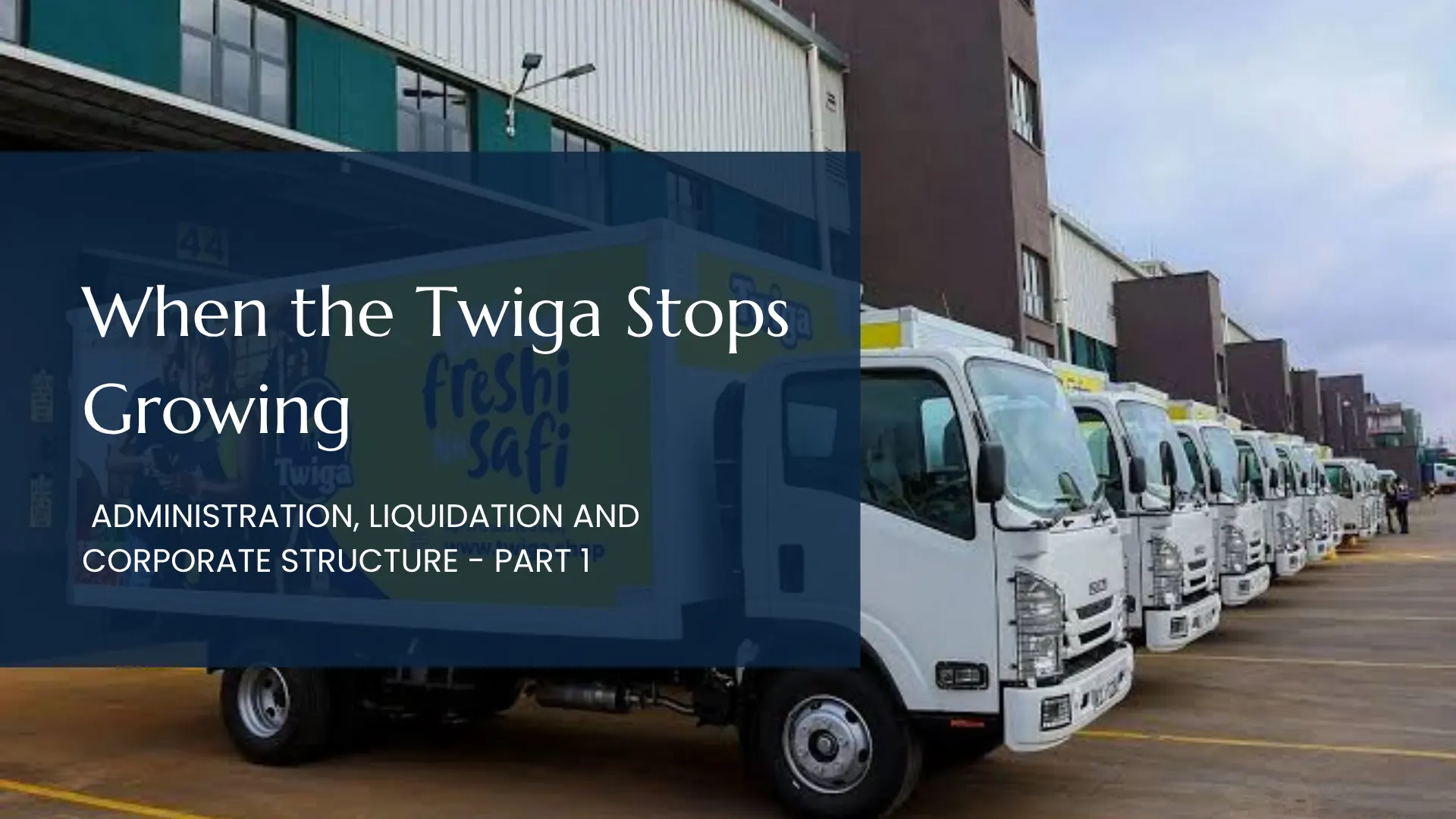
Twiga Foods represented the promise of Kenya’s technology and venture-capital ecosystem. Founded in 2014, the business sought to transform the fragmented food-distribution chain by connecting farmers directly with informal retailers through a technology-enabled distribution model. Over the course of its growth, Twiga attracted substantial institutional and venture capital investment, expanded its distribution infrastructure, diversified into fast-moving consumer goods and became one of the most prominent Kenyan startups.
The model worked well enough to scale. By 2017, Twiga had raised approximately US$10.3 million in its Series A, comprising equity and debt financing, with Wamda Capital leading the round alongside a group of institutional and impact investors. In 2018, it attracted a further US$10 million investment led by IFC and TLcom, and the business expanded beyond bananas into other fresh produce. By 2019, Twiga was working with more than 17,000 producers and approximately 8,000 retailers, illustrating how quickly the original banana-distribution model had evolved into a much larger technology-enabled distribution business. The company subsequently moved further into Fast Moving Consumer Goods (FMCG) distribution and built substantial logistics and warehousing infrastructure. In 2021, Twiga raised a US$50 million Series C led by Creadev, attracting another wave of international institutional capital. (See Wamda; International Finance Corporation (IFC); and Impact Africa, reports and publications on Twiga Foods and its funding and business expansion).
What began as an attempt to remove inefficiencies between a farmer and a retailer had therefore become something considerably more complex: a venture-backed corporate group with significant operational infrastructure, multiple financing arrangements, subsidiaries and other corporate interests.
The move followed a period of significant operational restructuring, including workforce reductions, changes to logistics and efforts to reduce the costs associated with the company’s distribution model. In 2025, Twiga also paused operations at its Nairobi distribution centre while undertaking a structural realignment following the acquisitions.
However, as at September 2026, Twiga’s trajectory presents a very different corporatelaw story. GT Flow Limited, formerly known as Twiga Foods One Limited, entered administration following an appointment by its board under Section 541(2) of the Insolvency Act, 2015.
The legal question?
The question is no longer simply whether Twiga Foods is in financial difficulty. It is also not whether any particular commercial decision was right or wrong. It is:
How does a company’s growth from a single operating business into a group of interconnected entities affect the legal rights, obligations and potential liabilities of the different companies within that structure?
As a business expands, what may initially appear to be a single corporate enterprise can develop into a more complex structure comprising;
- a holding company
- operating subsidiaries;
- asset-holding companies;
- property or special-purpose vehicles;
- intellectual-property ownership arrangements;
- financing vehicles;
- acquired businesses;
- intercompany loans;
- guarantees;
- security interests; and
- different classes of investors.
Once financial distress arises, that structure ceases to be merely an organizational convenience. It becomes central to determining where the creditor stands.
That is to say:
- Which Twiga entity owes the debt?
- Which entity owns the asset?
- Which entity entered the contract?
- Which entity received the financing? and
- What rights, if any, does a creditor have against the wider group?
One of the most important principles demonstrated by the Twiga situation is the doctrine of separate legal personality. A company incorporated as a separate legal entity has its own rights and obligations. Its shareholders, directors and affiliated companies do not automatically assume its liabilities. The Supreme Court’s treatment of corporate groups in Gatuma v Kenya Breweries Ltd [2024] KESC 52 (KLR) reinforces the proposition that companies within a group remain separate legal entities and that liability ordinarily rests with the entity that incurred it.
That is where corporate structure meets insolvency law under the options highlighted below.
Administration or liquidation?
Administration
Under Section 522 of the Insolvency Act, 2015, the objectives of administration are hierarchical.
- To maintain the company as a going concern;
- If that is not reasonably achievable, to achieve a better outcome for the company’s creditors as a whole than an immediate liquidation would produce; and
- Only as a last resort, to realize the property of the company in order to make a distribution to one or more secured or preferential creditors.
Administration can commence without any court involvement at all. It can be initiated by the company itself, its directors (under Section 541(2) or the holder of a qualifying floating charge under Section 534). This is precisely the route GT Flow’s board used. Once an administrator is appointed, an automatic moratorium takes hold: no legal proceedings, execution, or liquidation application may be commenced or continued against the company without the leave of the court or the administrator’s consent. That breathing space is the whole point of the regime; it buys time to negotiate rather than forcing an immediate scramble for assets.
Liquidation
Liquidation (or winding up), by contrast, is terminal. It exists to bring the company’s life to an end in an orderly way and distribute what remains among creditors and, if anything is left, shareholders. A creditor’s petition the route apparently taken against Twiga Tatu SEZ is typically grounded in an inability to pay debts as they fall due and it invites the court to appoint a liquidator whose task is realisation and distribution, not rescue.
The distinction can therefore be reduced to a simple proposition:
Administration asks whether value can still be rescued. Liquidation asks how the company’s affairs should be brought to an orderly end